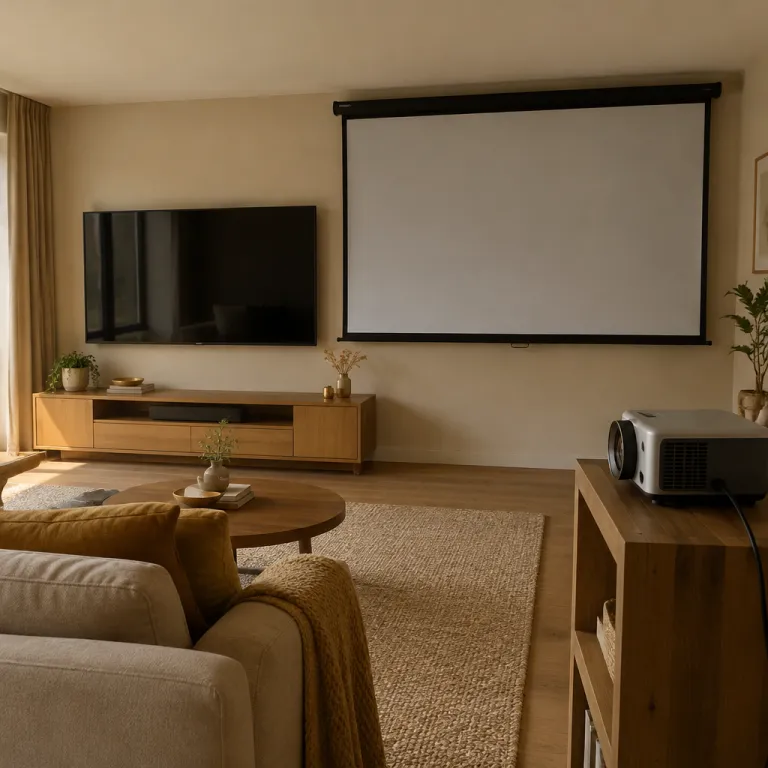
Home theater projector vs TV: how your room and habits decide
Choosing between a home theater projector and a TV starts with your room, not the spec sheet. In a bright living space with large windows, a television usually wins because its self illuminated panel can reach much higher brightness levels. In a dedicated dark room, the same comparison flips, and a projector can deliver a more cinematic, immersive image at a much larger size.
Most modern TVs comfortably hit 1 000 to 2 000 nits of peak brightness in independent tests (for example, RTINGS and HDTVTest measurements of recent OLED and mini LED models), while many home theater projectors output between 1 500 and 3 000 ANSI lumens. On a typical 100 inch screen in a dark room, that works out to roughly 80 to 200 nits of on screen brightness, depending on screen gain and calibration. That difference means a TV keeps contrast and color punch when sunlight hits the room, whereas a projector needs controlled lighting and often blackout curtains to compete. If you want a screen for everyday news, gaming, and casual streaming in a mixed use lounge, a TV based setup usually feels more practical and less fussy.
Projectors shine when you can sit at least 3 to 4 meters from the screen and dim the lights for movies or sports nights. In that scenario, a 100 to 120 inch image makes a 65 inch TV feel small, and the decision becomes about immersion rather than brightness alone. Think about how often you can darken the room fully, because your real life lighting habits will matter more than any marketing claim on the box.
Image quality, HDR, and color: where TVs still lead and where projectors catch up
When you compare projector and TV image quality, HDR performance is the first big divider. Expert testing consistently shows that projectors still trail TVs in peak brightness and native contrast for HDR content. For instance, a midrange OLED like the LG C3 or a mini LED set such as the Samsung QN90C can exceed 1 000 nits on small highlights, while popular 4K projectors like the Epson Home Cinema 5050UB or BenQ HT4550i typically land closer to the 100 to 200 nit range on screen in calibrated modes.
TVs deliver deeper perceived blacks because each pixel can dim independently (or in small local dimming zones), while most projectors rely on a single light source and a projection chip that cannot fully shut off light in dark scenes. That is why star fields, night cityscapes, and high contrast games look more precise and punchy on a TV, especially if you sit closer than 2.5 meters. In a side by side comparison focused on color accuracy, both technologies can be calibrated to reference standards, but televisions usually reach wider color gamuts and maintain saturation better in rooms with some ambient light.
Projectors fight back with size and a more film like presentation that many enthusiasts prefer for cinema content. A good 4K model on an ambient light rejecting screen can look wonderfully natural in a dim room, especially with laser or LED light engines that keep color stable over time. If you are also planning a smart doorbell upgrade and reading a smart doorbell comparison and reviews guide, think in the same structured way here, and weigh how you actually watch content before choosing between a projection based home theater and a large TV.
Screen size, seating distance, and cost per inch
Screen size is where the projector versus TV debate becomes most interesting for value. Large TVs above 77 inches still carry a steep price premium, while projectors can reach 100 to 120 inches at a far lower cost per diagonal inch. Industry comparisons and price tracking on major retailers suggest that projectors can be roughly 0.4 USD per inch cheaper than similarly sized TVs once you cross the 100 inch mark, which matters if you want a truly wall filling image.
For a cinematic field of view, many enthusiasts aim for a screen that fills about 40 to 50 percent of their horizontal vision. At a 3 meter seating distance, that usually means around 100 to 120 inches, which is where a front projection setup naturally becomes attractive. If you sit closer, say 2 to 2.5 meters, a 65 to 77 inch TV can still feel immersive without overwhelming the room, and the flat panel option becomes more balanced in terms of ergonomics and furniture layout.
Think about long term running costs as well as purchase price, just as you would when reading a breakdown like the cost per shave calculation nobody does. Lamps on traditional projectors eventually need replacement, while laser and LED models cost more upfront but last longer with lower maintenance. When you compare big screen options, calculate not only the initial spend but also the total cost of ownership over the years you expect to keep the display.
Room setup, installation, and everyday usability
Installation is often the hidden factor that decides a projector versus TV purchase. A TV is usually straightforward, with a stand or wall mount, a few cables, and built in smart apps ready to stream within minutes. A projector demands more planning, because you must consider throw distance, mounting position, cable routing, and whether you will use a fixed frame screen or a retractable model.
Traditional long throw projectors often sit 3 to 4 meters from the screen, which can mean ceiling mounting and running HDMI or network cables through the ceiling or walls. Ultra short throw models simplify this by sitting just centimetres from the wall, mimicking a TV placement on a low cabinet, yet they still need a flat wall or dedicated screen for best results. For quick news, kids’ cartoons, or casual YouTube, the instant on nature of TVs usually feels more convenient than waiting for a projector lamp or laser engine to warm up and cool down.
Noise and heat also matter in a quiet living room. Many projectors use active cooling fans that become audible in silent movie scenes, while modern TVs run almost silently except for occasional coil whine on some models. If you are already planning a connected home with a reliable smart hub and reading a guide on smart home hub setup made simple, treat the display decision as another infrastructure choice, and design cable management, power outlets, and control options around your preferred screen.
Gaming, sports, and mixed use: which suits your lifestyle
For gaming, the projector versus TV comparison revolves around input lag, motion handling, and brightness. Many gaming focused TVs now offer input lag well under 10 milliseconds at 4K 120 Hz in third party measurements (for example, RTINGS reports 5 to 9 ms on recent LG, Samsung, and Sony models), variable refresh rate, and HDMI 2.1 support, which makes them ideal for fast paced console or PC play. Projectors have improved, but plenty of models still sit in the 20 to 30 millisecond range or higher according to manufacturer specs and lab tests, which is acceptable for casual gaming yet less ideal for competitive shooters.
Sports viewing introduces another layer, because bright, colorful stadiums and fast camera pans benefit from strong motion processing and high brightness. A TV can keep the image vivid even with lights on and friends chatting, while a projector may look washed out unless you dim the room significantly. In a multi purpose family room that hosts daytime sports, kids’ shows, and evening movies, the television often wins for its balance of gaming performance, sports clarity, and daytime usability.
That said, a large projected image can make big events like football finals or racing weekends feel more like being in the stadium. If you mainly watch movies and prestige series in the evening, with occasional gaming, a good projector in a controlled light environment can still be the more emotionally engaging choice. Think honestly about how many hours you spend on each activity, then let that usage pattern guide your investment.
Budget tiers, future proofing, and when to choose each option
When you map budget tiers against performance, the landscape becomes clearer. At lower budgets, around the price of a solid midrange 55 to 65 inch TV, you will usually get better HDR, higher brightness, and simpler setup from the TV than from an entry level projector. As you move into higher budgets, projectors with laser light sources, better contrast, and ultra short throw designs start to compete more strongly, especially if you value screen size above all else.
Future proofing matters because display technologies evolve quickly, yet content standards like 4K HDR are already mature and widely supported. Most TVs in the midrange and above now offer 4K resolution, strong HDR formats, and smart platforms that receive regular updates, which makes them safe long term bets for mixed use homes. In a comparison focused on longevity, laser and LED projectors reduce worries about lamp replacements, while 8K TVs remain niche and unnecessary for typical viewing distances.
Use a simple rule of thumb to decide. Choose a TV if your main room is bright, you watch a lot of daytime content, or you prioritize HDR impact and gaming responsiveness. Choose a projector if you can darken the room, want a 100 inch or larger image, and are ready to invest some effort into setup, because that is where a carefully planned choice truly pays off in cinematic immersion.
Key figures for choosing between a projector and a TV
- Typical home theater projectors output around 1 500 to 3 000 ANSI lumens, which on a 100 inch screen in a dark room translates to roughly 80 to 200 nits of peak brightness. Many modern TVs reach between 1 000 and 2 000 nits according to comparative lab tests, which explains why televisions maintain HDR impact better in bright rooms.
- Cost analyses based on average retail pricing show that projectors can be roughly 0.4 USD per diagonal inch cheaper than similarly sized TVs once you move beyond about 100 inches of screen size, making projection more cost effective for very large images.
- Ultra short throw projectors can create 100 inch images from distances under 30 centimetres, whereas a traditional long throw projector might need 3 to 4 meters, which significantly affects installation planning and furniture layout.
- Many gaming oriented TVs now offer input lag under 10 milliseconds at 4K 120 Hz in independent measurements, while gaming capable projectors often sit closer to 20 to 30 milliseconds, which is fine for casual play but less ideal for competitive gaming.
- Laser and LED projectors frequently quote light source lifespans of 20 000 hours or more, compared with several thousand hours for traditional lamps, which reduces maintenance and supports long term home theater use.
FAQ: home theater projector vs TV
When should I choose a projector instead of a TV ?
Choose a projector if you can darken the room, sit at least 3 meters from the screen, and want a 100 inch or larger image for movies or sports. Projectors offer a lower cost per inch and a more cinematic feel in a dedicated or semi dedicated space. They are less suitable for bright daytime viewing or heavy HDR gaming in a typical living room.
When is a TV better than a projector for home theater ?
A TV is better when your main room is bright, you watch a lot of daytime content, or you prioritize HDR impact and gaming performance. Higher peak brightness and deeper perceived blacks make TVs stronger for mixed use spaces. They also start up instantly and integrate smart apps, which simplifies everyday use.
Are projectors really cheaper than TVs for large screens ?
For very large images above about 100 inches, projectors usually deliver a lower cost per diagonal inch than TVs. Analyses based on typical street prices suggest a saving of around 0.4 USD per inch compared with similarly sized flat panels. You should still factor in the cost of a screen and, for lamp based models, eventual lamp replacements.
Do projectors match TVs for HDR movies and series ?
Projectors have improved in HDR tone mapping, but they still lag behind TVs in peak brightness and contrast. This gap makes specular highlights and very dark scenes less impactful on most projectors, especially in rooms with any ambient light. For the most dramatic HDR experience, a quality OLED or mini LED TV remains the stronger choice.
Is an ultra short throw projector a good TV replacement ?
Ultra short throw projectors come closer to behaving like TVs because they sit near the wall and can be paired with ambient light rejecting screens. They work well in moderately lit rooms and offer very large images without ceiling mounts. However, they still cannot fully match the brightness, black levels, and instant simplicity of a good TV in every scenario.