Summary
Analysis score
Average of the criteria rated below
Value for money: dual-hose inverter without the big-brand price
Design and handling: big, wheeled, and focused on practicality
Build quality and reliability: early impressions from a small review base
Cooling performance and noise: strong output with a controversial fan behavior
Specs overview: dual hose, inverter, and numbers that look serious
Real-world effectiveness: room size, humidity, and electrical constraints
Pros
- Dual-hose design plus 10,000 BTU SACC for faster, more efficient cooling of larger rooms
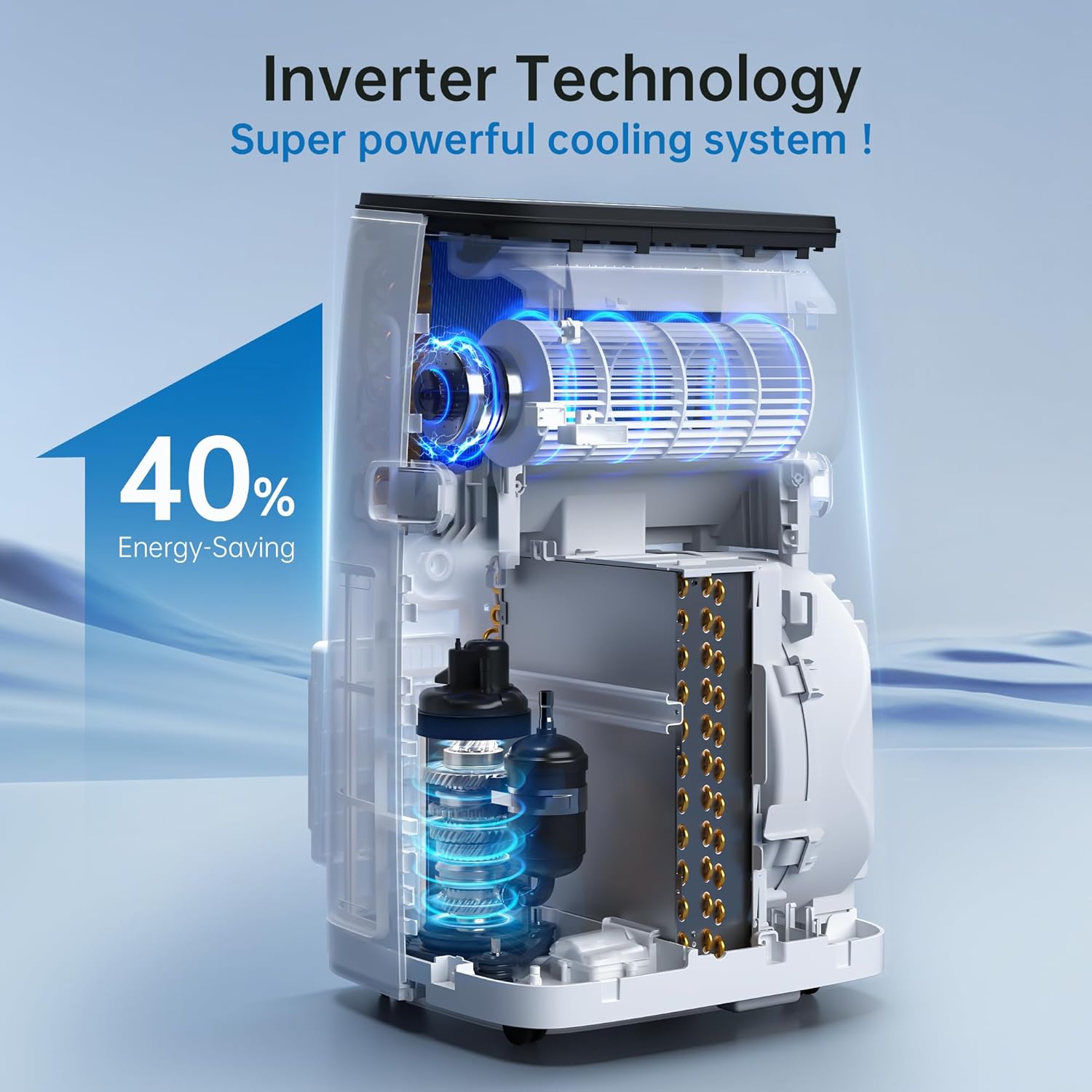
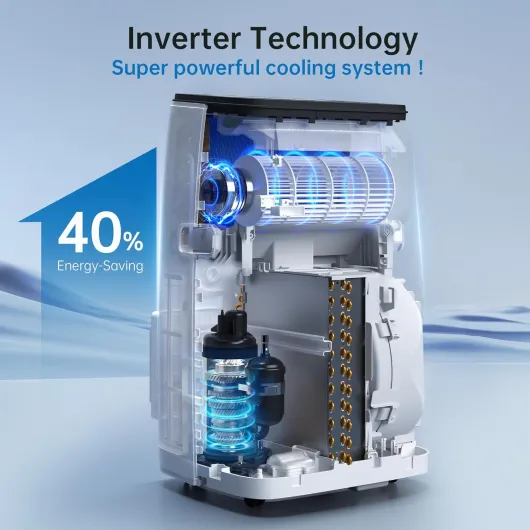
- Inverter compressor with claimed 40% energy savings and quieter sleep mode (around 42 dB advertised)
- Rich feature set: Cool/Fan/Dry modes, strong dehumidification, auto-swing, 24h timer, backlit remote, easy-to-clean filters
Cons
- Requires a 20A circuit for reliable operation, which may mean electrical work in some homes
- No option to keep the fan running continuously while maintaining a set temperature in cooling mode
- Drainage becomes frequent or continuous in very humid rooms or when using dehumidifier mode extensively

Specifications
View full product page →| Brand | HUMHOLD |
A portable AC that aims higher than the usual single-hose boxes
The HUMHOLD 14000 BTU portable air conditioner sits in a segment where most models look similar and cut the same corners: single hose, fixed-speed compressor, noisy operation, and vague energy claims. Here, the spec sheet is more ambitious. You get a dual-hose design, an inverter compressor, and a claimed ability to cool up to 700 sq.ft The published Amazon rating is 4.1/5 from about 35 reviews, so feedback is mostly positive but not unanimous. Several buyers praise the quiet operation and cooling speed. Others highlight some functional quirks, especially around how the fan behaves once the set temperature is reached and the electrical requirements. That mix suggests a product that can work very well for some setups, but clearly not a perfect fit for every situation. The feature list is dense: 14,000 BTU (ASHRAE) / 10,000 BTU SACC, dual hose, inverter technology for claimed 40% energy savings, dehumidifier mode rated at up to 80–96 pints per day, and a quoted noise level of 42 dB in sleep mode. Add a 24-hour timer, auto-swing, and a backlit remote, and this unit tries to check most of the boxes for daily comfort in hot seasons. The brand itself, HUMHOLD, is not a household name but does appear in large retailers according to at least one buyer, which is a bit more reassuring than a totally unknown label. In my opinion, this portable AC is interesting mainly because of the combination of dual hose and inverter at a price that tends to undercut big names. It is not flawless: you have stricter electrical needs, an operating logic that will annoy those who like continuous fan, and some constraints with very humid rooms where drainage becomes mandatory. But for someone with a medium-to-large room, a suitable 20A circuit, and a focus on quieter, more efficient cooling, it looks like a serious candidate.
Value for money: dual-hose inverter without the big-brand price
The selling point of this HUMHOLD portable AC is its feature-to-price ratio. While the exact price is not stated here, the comments from buyers give some hints. One reviewer explicitly mentions choosing this model over a better-known brand like Dreo and using the savings to buy an extended warranty. That implies HUMHOLD undercuts the top players while still offering dual hose, inverter technology, and a 10,000 BTU SACC rating, which you usually find at a higher price point.
From a value standpoint, the strongest arguments are:
- Dual-hose design for more efficient cooling and less negative pressure in the room.
- Inverter compressor for potential 40% energy savings and quieter operation compared to fixed-speed competitors.
- High dehumidification capacity (up to 80–96 pints/day) for humid climates.
- Rich feature set: sleep mode, 24h timer, auto-swing, backlit remote, and no-drain operation in typical conditions.
On the other side of the balance, there are some costs and compromises that affect perceived value. The requirement for a 20A circuit can be a hidden expense if you need an electrician to add a dedicated line. The lack of an option to keep the fan running while the compressor cycles is a real downside for users who value continuous air movement at a stable temperature; one 2-star review is almost entirely about this complaint. And because HUMHOLD is not a premium brand, resale value and brand-backed long-term support are more uncertain compared to big names.
In my opinion, if you specifically want a dual-hose inverter portable AC and you have a compatible electrical setup, this model offers good value for money. You are essentially getting the core technologies of more expensive units at a lower entry price, with the trade-off of a less-known brand and some quirks in how the unit operates. For users who just need a small, cheap, plug-and-play unit for a tiny bedroom on a 15A circuit, this is probably overkill and not the best value. But for someone cooling a larger room and willing to think about installation details, the cost-benefit ratio looks favorable.
Design and handling: big, wheeled, and focused on practicality
Visually, this HUMHOLD portable AC follows the classic tall white tower style: free-standing, rectangular, and fairly deep. With dimensions around 33D x 40.6W x 68.6H cm and a weight of about 64–65 lbs, it is clearly not a compact device, but that is the norm for a 14,000 BTU-class portable. The brand tries to offset this bulk with four heavy-duty caster wheels and hidden side handles, so you can roll it between rooms instead of carrying it. Buyers who mention mobility seem to find it manageable, as long as you are not moving it up and down stairs all the time.
The front panel has an easy-to-read display and button control panel, while the remote features a backlit LED screen and works from up to about 28 feet. That combination means you do not have to walk up to the unit to change modes or temperature, which is especially handy if it is placed across a larger room. The remote uses two AAA batteries that are not included, which is minor but worth noting if you want to use it right away.
The auto-swing function covers roughly 30–85°, which helps blow air across a wider area instead of just straight ahead. One buyer mentions being able to enjoy the cool air from a sofa or bed without the unit blasting directly in the face, which suggests the airflow direction is reasonably well thought out. The design also integrates easy-access air filters that can be removed without tools and washed under running water, which should simplify basic maintenance and keep performance more stable over time.
For installation, the unit comes with a window sealing kit and exhaust hose that fits most sliding vertical or horizontal windows. Instructions describe a fairly simple sequence: stick sealing foam, adjust the panel, and connect the hose to both the AC and the panel. One reviewer says if you can tie your shoes, you can have it running in under 20 minutes, which indicates the overall design of the kit is not overly complicated. The only caveat is for users with very small or unusual windows: one positive review mentions having to improvise because the provided sliding expander did not fit, even though the user still described the overall installation as easy.
In my opinion, the design is practical and aligned with the segment: not stylish, but functional. The big pluses are the auto-swing, readable front display, and remote with backlight. The downsides are inherent to this type of product: it is bulky, the hose and window kit are visible, and those with non-standard windows may need some DIY. But there is nothing alarming in the design choices, and the feedback from buyers is generally that it “looks fine” and especially that it is a good replacement for bulky window units from an aesthetic standpoint.
Build quality and reliability: early impressions from a small review base
With only around 35 reviews and an average of 4.1/5, it is a bit early to draw strong conclusions on long-term durability, but a few indicators can be read between the lines. First, there are no widespread reports of catastrophic failure in the first weeks of use, which is already a good sign in this price range where some no-name portables fail out of the gate. One buyer explicitly says they see "no reason to expect a failure" after a week of use and felt confident enough to pair the unit with an extended warranty instead of paying for a more expensive big brand model.
The components listed are fairly standard: R32 refrigerant, a variable-speed inverter compressor, plastic housing, and washable filters. R32 is commonly used in modern AC systems and is not a red flag by itself. The inverter compressor can, in theory, be gentler on the hardware because it avoids constant full-power cycling, which might help longevity if the electronics are well designed. On the other hand, when inverter systems fail, repairs tend to be more complex and expensive than simple fixed-speed units, which is probably why at least one buyer decided to purchase an extended warranty for peace of mind.
From a physical standpoint, the 65 lb weight and general dimensions suggest a fairly dense build with a substantial compressor and heat exchangers. The included wheels and handles should help prevent accidental drops during moves, which is important since impacts are a common cause of premature failure in portable units. The washable filters are also a plus for durability, because keeping coils clean reduces strain on the compressor and fans.
So far, the negative feedback is more focused on functional limitations (fan not staying on with the compressor off, electrical circuit requirements) than on broken parts, leaks, or dead units. That does not guarantee long-term reliability, but it is still meaningful. In my opinion, this looks like a typical mid-range Chinese-manufactured unit: decent build for the price, no obvious design disaster, but not the kind of product you buy expecting 15 years of trouble-free operation. Pairing it with an extended warranty, as one user did, is a rational move if you want to hedge against the risk of compressor or electronics failure after the standard warranty period.
Cooling performance and noise: strong output with a controversial fan behavior
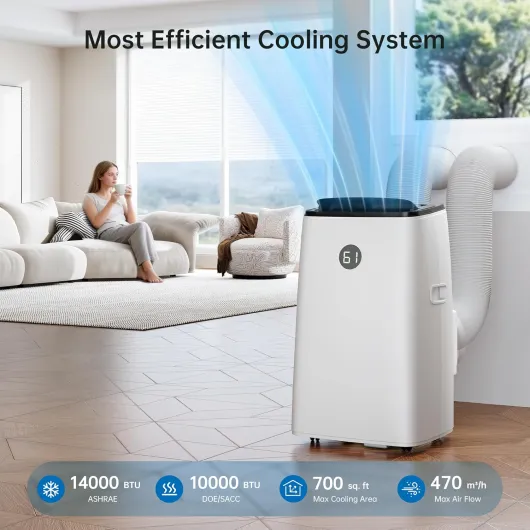
On the performance side, the combination of 14,000 BTU (10,000 SACC), dual-hose design, and inverter compressor suggests this unit should cool faster and more efficiently than a typical 10,000–12,000 BTU single-hose portable AC. Several reviewers explicitly say it cools fast, including one who mentions replacing a window unit and being fully satisfied with the result. Another buyer who uses it in a three-season room in Middle Tennessee in June reports that, once the electrical circuit issue was solved, the unit kept the room comfortable enough to pair it with a heater for year-round use. These comments line up with the spec sheet: the hardware should be more than enough for a well-insulated medium-to-large space.
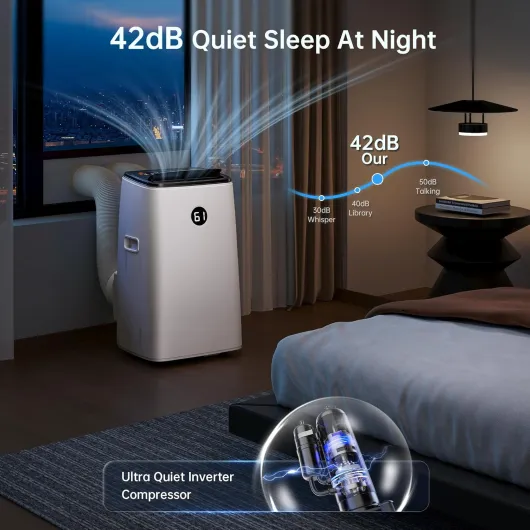
Noise is a common pain point with portable ACs, so the claimed 42 dB in sleep mode is an important point. One review calls the unit “super quiet” and highlights this as one of the reasons they are happy they chose it. While 42 dB is likely measured in a specific low-power condition and not at full blast, it still indicates that HUMHOLD is trying to keep sound levels under control. The inverter compressor should also help, since it can run at lower speeds instead of constantly switching on and off at full power, which usually generates more noise.
However, there is a functional behavior that divides opinions. A detailed 2-star review points out a major annoyance for that user: in cooling mode, once the room reaches the set temperature (for example, 72°F), the unit shuts down completely, including the fan. There is no option to keep the fan running continuously while the compressor cycles. You can switch to fan-only mode, but then the unit no longer cools. The reviewer notes they have never seen an AC without the option to keep the fan going while maintaining the set temperature, and this was a deal breaker for them, especially for overnight use where they wanted both cooling and constant air circulation.
In my view, cooling performance itself looks solid, and most buyers who focus on cold air output are satisfied. The dual-hose plus inverter combo is a real advantage compared to the cheaper single-hose, fixed-speed crowd. The main performance drawback is not raw power but control logic: if you are used to central air or window units where the fan can stay on continuously while the compressor cycles, this design may frustrate you. For users who do not care about continuous fan and just want the room to reach temperature and then quiet down, this behavior could even be seen as a plus. So this point is less about capability and more about whether the unit’s operating style matches your habits.
Specs overview: dual hose, inverter, and numbers that look serious
The central promise of this unit is straightforward: portable cooling for up to 700 sq.ft14,000 BTU (ASHRAE 128) and 10,000 BTU SACC. SACC is the more realistic standard for portable units, and 10,000 is decent for a large bedroom, living room, or a well-insulated open space. It runs on standard 115V AC but draws up to 1,250 watts, with an estimated annual energy consumption of 500 kWh under typical use scenarios.
What really stands out on paper is the combination of dual-hose design and inverter compressor. The brand claims the dual hose increases cooling speed by 40–50% because one hose brings in intake air while the other exhausts hot air, instead of pulling already cooled room air like a single-hose system. The inverter is advertised to save about 40% energy by modulating compressor speed instead of cycling on/off at full power. Several buyers specifically mention they chose this model because of these two technologies, seeing them as must-haves compared to basic units.
The unit offers 3 operating modes: Cool, Fan, and Dry (dehumidifier). Temperature adjustment in cooling mode ranges from 61–90°F, which covers most use cases. The dehumidifier is rated at 80–96 pints per day, which is quite high on paper and should be enough to handle sticky basements or humid climates, provided you accept the need for drainage. There is also a 42 dB "quiet" sleep mode with a 24-hour timer, and an auto-swing function from 30–85° to distribute air better across the room.
The spec sheet lists a weight of about 64–65 lbs and dimensions of roughly 13" W x 16" D x 27" H (33 x 40.6 x 68.6 cm). So it is not tiny, but that is expected for this cooling capacity. Accessories include a window sealing kit with hose, remote control (batteries not included), and a user guide. On paper, it is a complete package: no extra purchase required for standard window venting, and the unit is free-standing, so no outdoor unit or permanent installation is needed.
In my view, the raw specs are solid for the category. You get real dual-hose, realistic SACC numbers for a mid–high-range portable, and energy-saving features usually seen in pricier models. The main catch is not in the numbers, but in the operating constraints (20A circuit recommendation, drainage in high humidity) and some functional choices, which show up in the reviews rather than the spec sheet itself.
Real-world effectiveness: room size, humidity, and electrical constraints
Effectiveness is not only about how many BTUs are printed on the box; it is also about how the unit deals with real conditions: room size, insulation, humidity, and power supply. The manufacturer claims this HUMHOLD unit can handle up to 700 sq.ft, which is ambitious but not unrealistic for 10,000 BTU SACC in a reasonably insulated space. Reviews from people using it in larger rooms, like a three-season room, generally confirm that it can make the space comfortable in summer, especially when combined with proper power supply and window sealing.
Humidity is a key parameter here. The unit has a Dry/Dehumidify mode with a rating of 80–96 pints per day, which is high for a portable AC. However, the manual and product description are clear: in very humid environments (around 80–85% humidity, such as basements or laundry rooms), you will need to drain the unit regularly or use continuous drainage. The built-in tank will fill up in roughly eight hours in those conditions, and the unit will stop automatically to prevent leaks. HUMHOLD includes a drain hose in the package, and you can connect it to the rear drain port for continuous drainage, which is basically mandatory if you want to run it long hours in very humid spaces.
There is also a specific constraint around the electrical circuit. One detailed review explains that on a 15A circuit, the unit would run for about five minutes and then shut off. The instructions apparently call for a 20A circuit, and once the buyer had an electrician install a dedicated 20A receptacle, the unit worked reliably and they were very happy with it. This is important: if your room is wired with a typical 15A circuit already loaded with other devices, you might run into nuisance trips or shutdowns. Checking your breaker panel beforehand is strongly recommended.
On the positive side, some features improve day-to-day effectiveness. The brand mentions that in typical cooling mode, you do not need to manually drain water because condensate is evaporated and exhausted via the hose. Only in extreme humidity or dehumidifier mode does drainage become a regular task. The 24-hour timer and sleep mode also help tailor usage to your schedule, avoiding unnecessary operation and improving comfort at night. Taken together, these elements show a unit that can be very effective if used within its constraints: adequate circuit, proper window installation, and planned drainage in humid conditions.
In my opinion, the effectiveness story is solid but conditional. For a standard bedroom or living room on a 20A circuit, with normal humidity, this portable AC should handle cooling duties without much fuss and with decent efficiency. If you are targeting a damp basement or a marginal electrical installation, you need to go in with your eyes open: expect to deal with drainage and possibly electrical upgrades. That is not unique to this model, but the reviews make it clear that ignoring these aspects can lead to frustration.
Pros
- Dual-hose design plus 10,000 BTU SACC for faster, more efficient cooling of larger rooms
- Inverter compressor with claimed 40% energy savings and quieter sleep mode (around 42 dB advertised)
- Rich feature set: Cool/Fan/Dry modes, strong dehumidification, auto-swing, 24h timer, backlit remote, easy-to-clean filters
Cons
- Requires a 20A circuit for reliable operation, which may mean electrical work in some homes
- No option to keep the fan running continuously while maintaining a set temperature in cooling mode
- Drainage becomes frequent or continuous in very humid rooms or when using dehumidifier mode extensively
Conclusion
Analysis score
This HUMHOLD 14000 BTU portable air conditioner targets a slightly more demanding audience than the usual budget portables. With its dual-hose layout and inverter compressor, it aims to deliver faster, more efficient, and quieter cooling for rooms up to about 700 sq.ft. The Amazon feedback (around 4.1/5) backs this up: many buyers highlight strong cooling performance, low noise in practice, and relatively easy setup, especially compared to bulky window units. For someone who wants serious portable cooling without paying top dollar for a big name, this unit has a lot going for it.
It is not without drawbacks. You really should have a 20A circuit available; trying to run it on a loaded 15A line is asking for shutoffs. In very humid environments, you also need to accept regular or continuous drainage. And the operating logic where the fan stops completely once the set temperature is reached in cooling mode will annoy users who like continuous airflow while maintaining a set temperature. These are not deal breakers for everyone, but they are important to know before buying.
In my opinion, this portable AC makes the most sense for users who: have a medium-to-large room with a proper 20A outlet, care about energy efficiency and noise, and specifically want dual-hose performance. It is less suited to people on weak circuits, those who hate any drainage work, or those who insist on continuous fan operation with thermostat control. If you fall in the first group and are fine with a lesser-known brand, the overall package looks like a solid, well-equipped option at a competitive price.