Summary
Analysis score
Average of the criteria rated below
Value for money: who should actually buy this
Design and installation: big, functional, and a bit finicky at the window
Build quality, drainage, and early‑life reliability
Noise, energy use, and real‑world behavior
What the Gasbye CoolPrime 10000 actually offers
Cooling effectiveness: dual hose and inverter doing real work
Pros
- Dual‑hose design with 10,500 BTU SACC, suitable for fast cooling of rooms up to about 500 sq ft
- Full DC inverter compressor for lower noise and better energy efficiency (13.6 CEER/SEER)
- Consistently positive buyer feedback on cooling power and quiet operation, especially at night
Cons
- Remote control is confusing and requires strict line of sight, according to several buyers
- Bulky and heavy unit with a window kit that may need cutting or DIY adjustments for some windows

Specifications
View full product page →| Brand | Gasbye |
A portable AC that finally takes noise and efficiency seriously
The Gasbye CoolPrime 10000 positions itself as a higher‑end portable AC for people who are tired of loud, inefficient single‑hose units. On paper, it combines several interesting features: a dual‑hose design, a full DC inverter compressor, and a strong energy efficiency rating of 13.6 CEER/SEER. It is advertised at 14,000 BTU (ASHRAE) and 10,500 BTU SACC, which is the more realistic cooling capacity metric. That SACC number places it in the upper mid‑range of portable units and should be enough for medium to large rooms.
Among the Amazon comments, the tone is clearly positive: a 4.7/5 average across a few dozen reviews is solid for a niche product from a relatively unknown brand name. Buyers repeatedly highlight two things: cooling power and low noise, especially compared with older single‑hose models from established brands. Several people also call out the dual‑hose and inverter combo as the main reason they picked this machine over cheaper options.
There are downsides. This is not a compact or featherweight device at about 65 lb and roughly 74 cm tall. The window kit is described as serviceable but not very flexible, and at least one buyer had to cut plastic panels to adapt them to a sliding window. The remote is another recurring complaint: it works, but the logic and line‑of‑sight requirement frustrate some users. So it is not a polished smart‑home appliance; it is more of a functional cooling tool with a few rough edges.
In my opinion, the overall picture is clear: if you want the quietest and most efficient portable AC possible without going to a full split system, this Gasbye model looks like a serious candidate. If you want something ultra‑simple, lightweight and cheap just to cool a tiny room, there are easier and less expensive options, but they will likely be noisier and less efficient.
Value for money: who should actually buy this
Price fluctuates, but comments indicate that the Gasbye CoolPrime 10000 sits north of $500, so it is clearly not a budget portable AC. The value question is whether the dual‑hose design, inverter compressor, and high CEER justify paying more than for a basic single‑hose 10,000 BTU unit. In my opinion, for people who care about noise, power consumption, and real‑world cooling efficiency, the answer leans toward yes. You are effectively paying for better engineering: more stable room pressure, smoother compressor operation, and lower energy use for the same or better comfort.
Compared with cheaper portable ACs, you get:
- Dual‑hose airflow, which reduces negative pressure and hot air infiltration.
- Full DC inverter compressor, rare in this category, which improves both noise and efficiency.
- Higher SACC rating (10,500 BTU) than many nominal “12,000–14,000 BTU” units that often have lower real‑world output.
- A backlit remote and a reasonably flexible control panel with modes like Turbo and Inverter.
On the flip side, you give up some things. There is no Wi‑Fi or app control, which some similarly priced models now offer. The window kit is functional but not especially premium, and at least one user had to cut and screw pieces together to fit a sliding window. The remote interface is widely criticized as confusing, which is annoying at this price. And the unit is fairly large and heavy, so if you just want a lightweight, plug‑and‑play unit for a small bedroom, you may feel you are paying for capacity and technology you do not really need.
The Amazon 4.7/5 average rating with more than 60 reviews is a strong signal that most buyers feel they got their money’s worth. People who upgraded from older single‑hose portables repeatedly say the Gasbye is in “a different league” in terms of cooling speed and noise. If you are debating between a mid‑range single‑hose and this model, and you plan to run it many hours per day over several summers, the energy savings and comfort benefits could easily justify the higher upfront cost. If you only need occasional spot cooling in a mild climate, a cheaper unit is probably a more rational choice.
Design and installation: big, functional, and a bit finicky at the window
The design of the Gasbye CoolPrime 10000 is clearly function‑first. At roughly 74 cm tall and 45 cm wide, it takes up a solid footprint next to a window. Several buyers mention that the unit feels sturdy and well built rather than flimsy, which matches the 29.5 kg weight. This is not a slim, decorative tower; it is a chunky appliance that looks like a typical modern portable AC in white plastic with a front air outlet and rear hose connections. One buyer liked the small detail that the air outlet louver glides shut when not in use, which gives the front a cleaner look and keeps dust out of the vents.
Installation is where comments diverge slightly. The manufacturer specifies that the window kit can adapt to openings with a minimum height of 25 cm and maximum of 51 cm, and a maximum width of 76.5 cm. In practice, buyers with standard vertical sash windows report that setup is doable without tools, but sometimes requires patience to fit the panels and foam properly. One detailed review describes having to cut the main panel and join it with an extension using screws to adapt to a specific window design. That is not unusual for portable ACs, but it means you should expect some DIY if your window is non‑standard.
The dual‑hose system takes more space and attention than single‑hose kits. You need to connect both intake and exhaust hoses to the window plate and position the unit so the hoses are not kinked. One buyer notes that the exhaust hose can get quite hot and strongly recommends adding inexpensive insulating hose sleeves to reduce heat radiation back into the room. That is not a fault of this model in particular; it is a known quirk of all portable ACs with plastic hoses. Still, if you want the cleanest installation, plan for a bit of extra spending and time to insulate and seal everything.
Control‑wise, people are generally positive about the on‑unit control panel, describing it as clearly labeled, with straightforward access to modes, fan speeds, and a turbo function. The remote, on the other hand, is a pain point. One long review calls it confusing and unreliable because it sends the entire configuration each time rather than only the last button press, and it needs a direct line of sight. That can lead to situations where multiple queued button presses suddenly hit the unit at once, changing several settings unexpectedly. From a design point of view, the hardware is fine, but the user interface logic of the remote is clumsy. If you like simple controls, you may end up ignoring the remote and relying on the top panel instead.
Build quality, drainage, and early‑life reliability
Durability is always hard to judge early on, but some signals are available. Physically, the CoolPrime 10000 is heavy at around 65 lb, which usually indicates a decent amount of metal and a robust compressor rather than ultra‑thin plastic everywhere. Several buyers explicitly describe the unit as solidly built and “sturdy,” which suggests that the casing and internal structure do not feel flimsy. The fact that manufacturing is tied to TCL/Delonghi’s factory also hints that this is not a random white‑label product from an unknown plant.
Regarding drainage and leaks, which are common weak points in portable ACs, comments so far are positive. One reviewer who took extra precautions with a silicone mat under the unit reports that they have not seen any leaks from the drain port or unexpected water escape when opening the plug. Another buyer says they have only used it in AC mode and have seen “no hint of any kind of water leakage.” The machine is designed to be self‑evaporating in typical conditions, so the compressor heat evaporates most of the condensate and expels it through the exhaust hose. Manual drainage should only be necessary in very humid environments or specific modes.
From a design perspective, the presence of an upper rear drain outlet is a small but practical durability feature. Many portable units only have a low drain plug near the floor, which can be a pain to access and can encourage users to skip draining until the unit overflows or errors out. Having a higher drain option should reduce stress on seals and internal reservoirs when manual drainage is needed. There is no wave of complaints in the comments about cracks, broken fittings, or failing pumps, which is a good sign at this stage.
On the electronics side, the main negative durability‑adjacent feedback concerns the remote control behavior, not outright failure. People call it confusing and fussy, but not necessarily fragile. One buyer also mentions registering for an extra warranty (three years total) and being satisfied with the vendor’s email support. That extended coverage, combined with a relatively high number of 5‑star reviews and no visible pattern of early breakdowns, suggests that reliability is at least decent so far. That said, portable ACs in general have a reputation for shorter lifespans than fixed systems, so if you plan to run this unit heavily every summer, it is reasonable to set expectations around several years of service rather than a decade‑long investment.
Noise, energy use, and real‑world behavior
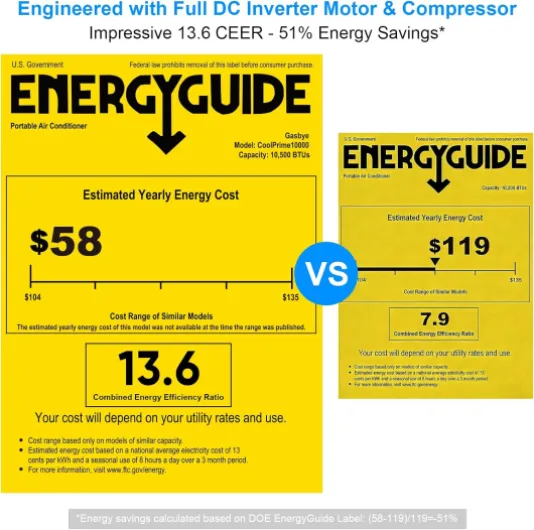
Performance here goes beyond pure cooling power. The two standout claims are low noise (around 45 dB) and high efficiency (13.6 CEER/SEER). Those numbers immediately put this Gasbye ahead of many older portables that are noisy and power‑hungry. In the Amazon comments, several buyers say the unit is much quieter than their previous portable ACs. One person compared it to a Danby unit from around 2012 and described the old compressor as producing random jolts loud enough to wake people up, whereas the Gasbye, even in Turbo mode, is described as being not much louder than a white noise machine.
The inverter compressor is central to this. Instead of slamming on at full speed, it can operate at partial load, which both reduces energy usage and smooths out sound levels. There are reports that in Inverter mode, the compressor ramps down after initial cooling and becomes noticeably quieter while still maintaining temperature. Another buyer notes that even with the fan on high, this machine is about “50% quieter” than their previous single‑hose unit. Obviously that is subjective, but the pattern in the comments is consistent: people who are sensitive to noise find this unit more tolerable for sleeping and working than many alternatives they used before.
On the energy side, the 13.6 CEER/SEER rating and 1290 W power draw are decent for the capacity. Portable units are inherently less efficient than well‑installed window or split systems, but within the portable category this one is on the efficient end. The brand even suggests an interesting strategy for very humid environments: pairing the AC with a separate dehumidifier (300–500 W) so the AC can focus on cooling. That is a niche use case, but it shows that the design is meant to prioritize efficient cooling rather than heavy dehumidification duty.
Behavior under continuous use also looks reassuring so far. Buyers who ran the unit through heatwaves say it kept up with demand and did not trip breakers or show obvious overheating issues. One person mentions using a silicone mat under the unit as insurance against potential leaks and notes that they have not seen any water escape. Another buyer contacted support to register for an extended warranty and reported that the Gasbye representative was responsive and helpful. While that is only one data point, it suggests there is at least some after‑sales structure behind the brand. Overall, in my opinion, the performance profile is one of the main selling points: quiet operation, relatively frugal energy use for the output, and stable behavior under real summer loads.
What the Gasbye CoolPrime 10000 actually offers
On paper, the Gasbye CoolPrime 10000 is a dual‑hose, 14,000 BTU (ASHRAE) / 10,500 BTU (SACC) portable air conditioner aimed at rooms up to about 500 square feet. It runs on standard 115 V power and draws about 1290 W, with an advertised annual energy consumption of 442 kWh. The key technical point is the full DC inverter compressor, which allows the machine to modulate its output instead of just cycling fully on and off. That is rare in portable units and usually reserved for higher‑end split or window systems.
The unit is relatively large for a portable model: 39.4 × 45 × 74.4 cm and about 65 lb (around 29.5 kg). It is still classified as portable, with casters to roll it, but this is not something most people will want to carry between floors every day. The form factor is tower‑like, with front air outlet louvers and the two hoses connecting at the rear to a window kit. The manufacturer states a noise level of 45 dB, which is significantly lower than many older portables that often run in the 55–65 dB range.
Functionally, it is a 3‑in‑1 device: air conditioner, fan, and dehumidifier. There is a dedicated dehumidifier mode, and the documentation claims that in normal use you rarely need to drain water manually thanks to an internal evaporation system. When humidity is very high (over about 85% relative humidity), manual drainage may become necessary. Gasbye has added a secondary drain outlet located high on the back of the unit, which should make occasional draining easier than on models that only have a bottom drain plug.
The package includes the double hose set, a window ventilation kit, and a backlit remote control, which is useful for night‑time adjustments. The manufacturer name in the technical data refers to TCL Delonghi Home Appliances (Zhongshan) Co., Ltd., which suggests production by an experienced OEM, even if the Gasbye brand itself is not widely known. In short, the spec sheet suggests a fairly serious portable AC that tries to compete more on engineering (dual hose + inverter + efficiency) than on flashy design or smart features.

Cooling effectiveness: dual hose and inverter doing real work
On the effectiveness front, the CoolPrime 10000 looks strong. The 10,500 BTU SACC rating is the key figure; this is the standardized metric that takes into account real‑world losses like duct heat and infiltration. For a portable unit, that is a solid number and fits the advertised coverage of up to 500 sq ft. Public reviews back this up: multiple buyers say it cools their spaces quickly and without struggle. One verified purchaser with a 600 sq ft bedroom reports that the unit can pull the temperature down to around 70°F in roughly 20 minutes, which is quite good for a portable system.
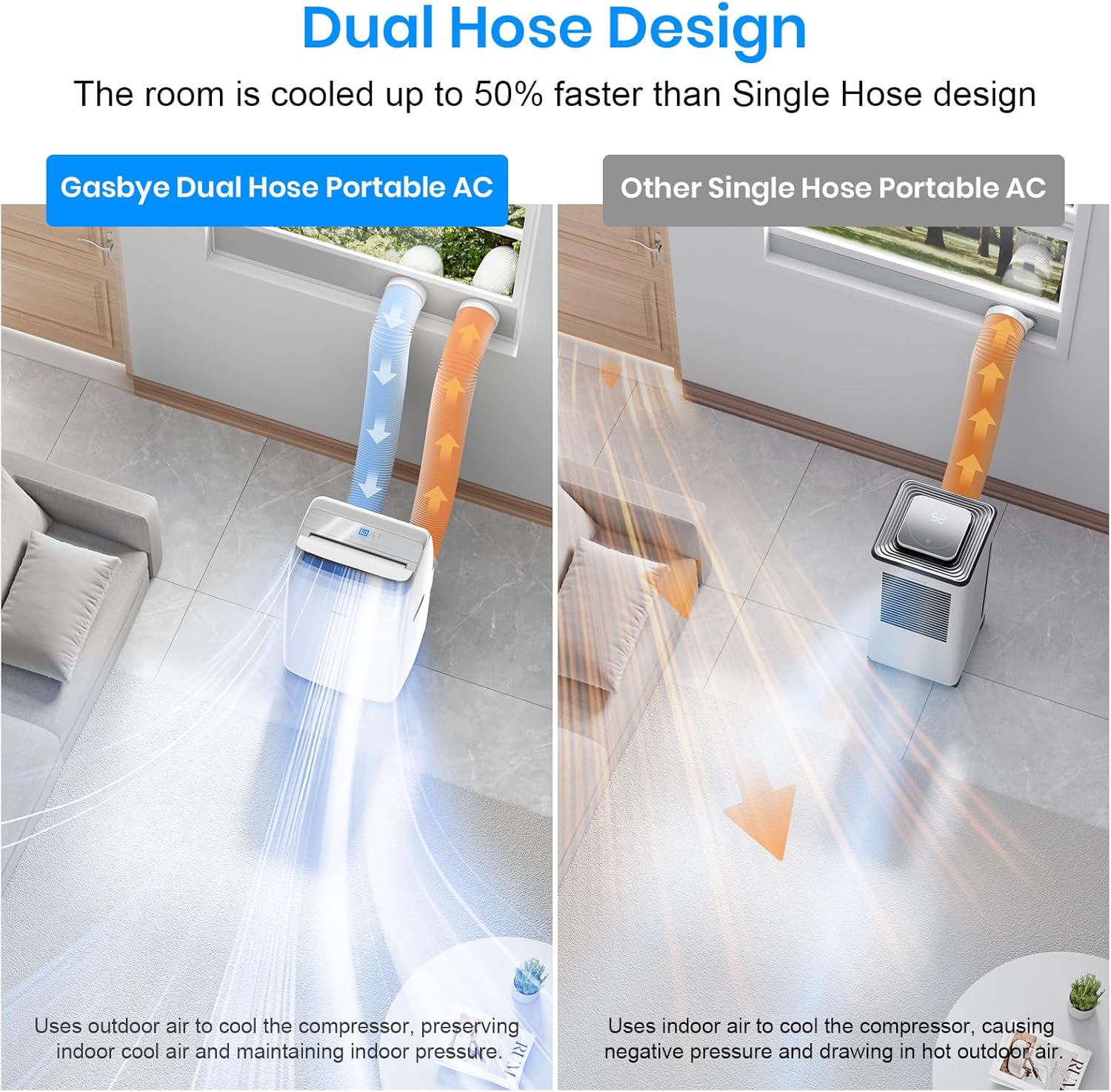
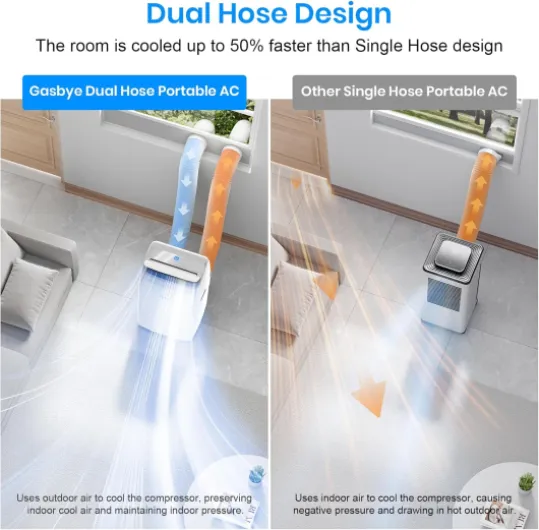
Several comments compare this Gasbye to older single‑hose units from brands like Danby or Whynter. The recurring theme is that single‑hose models often create a vacuum effect that pulls hot air in from other parts of the home, which reduces effective cooling. The dual‑hose design here avoids that by bringing in outside air through one hose and exhausting hot air through the other, so the room pressure stays closer to neutral. Buyers report that this translates into faster cooling and a more stable temperature, especially in semi‑open layouts. One user describes cooling not just a 15×20 living room but also an adjacent dining area, two short hallways, and a galley kitchen, saying the Gasbye handled that better than their previous unit.
The inverter compressor also matters for real‑world effectiveness. Instead of just blasting at full power and then shutting off, it can ramp output up and down. The machine offers different modes like standard Cool, Turbo, and a dedicated Inverter mode. According to the manual quoted by a buyer, a recommended pattern is to run Turbo for a while to quickly reach the desired temperature and then switch to Inverter mode to maintain it quietly. In practice, reviewers say this works: the unit drops the temperature quickly, then holds it without big swings and without the jarring compressor starts that plague older designs.
Humidity handling is another piece of the effectiveness puzzle. The CoolPrime has a dehumidifier mode and, like all ACs, naturally removes moisture from the air when cooling. One reviewer in a humid region mentions that, even in rainy weather, they did not yet have to drain water manually, which lines up with the claimed self‑evaporating system. The brand notes that in very humid environments you might still need to drain occasionally, but the added upper drain port should make that less of a hassle. Overall, on cooling power and climate control, this unit looks very capable for small to mid‑size apartments, bedrooms, and living rooms, provided you install the window kit carefully and avoid major air leaks.
Pros
- Dual‑hose design with 10,500 BTU SACC, suitable for fast cooling of rooms up to about 500 sq ft
- Full DC inverter compressor for lower noise and better energy efficiency (13.6 CEER/SEER)
- Consistently positive buyer feedback on cooling power and quiet operation, especially at night
Cons
- Remote control is confusing and requires strict line of sight, according to several buyers
- Bulky and heavy unit with a window kit that may need cutting or DIY adjustments for some windows
Conclusion
Analysis score
The Gasbye CoolPrime 10000 comes across as a serious portable AC for users who are tired of noisy, inefficient single‑hose boxes. On paper, it combines three important elements: dual hoses, a full DC inverter compressor, and a high CEER/SEER of 13.6, backed by a realistic 10,500 BTU SACC rating. In the public reviews, that translates into quick cooling of 300–500 sq ft spaces, fewer temperature swings, and much quieter operation than older units from well‑known brands. Several buyers openly say it handled larger or more open spaces than their previous machines could manage.
It is not perfect. The remote control logic is confusing and frustrates more than one owner. The window kit works but may require cutting and fiddling, especially on sliding windows. The unit is large and heavy, so it is best treated as a semi‑fixed appliance you roll a bit rather than something you carry around the house. There are also no smart features like Wi‑Fi, which some people now expect at this price level.
In my opinion, this model makes the most sense for someone who: wants strong cooling for a medium‑to‑large room, cares a lot about noise at night, and is willing to spend more for better efficiency and comfort. If your budget is tight, your room is small, or you just want a plug‑and‑play solution you barely think about, a cheaper, simpler single‑hose portable might be enough. But for buyers who prioritize performance and are ready to wrestle a bit with installation and an awkward remote, the Gasbye CoolPrime 10000 looks like a well‑engineered option with good feedback from real‑world use.