Summary
Analysis score
Average of the criteria rated below
Value for money: where this GE unit makes the most sense
Compact, plain design focused on practicality
Comfort, noise, and everyday experience according to buyers
Build, filter, and long-term reliability signals
Cooling performance and noise: how it holds up in real rooms
What this 5,000 BTU GE window unit actually offers
Pros
- Strong cooling for small rooms compared with many portable ACs
- Simple, durable mechanical controls with no complex electronics
- Compact and relatively light design with EZ Mount kit for easier installation
Cons
- Limited to small rooms around 150 sq ft; underpowered for larger spaces
- No timer, remote, or smart features; very basic feature set
- Air outlet lacks vertical adjustment and the filter can be fiddly to reinsert

Specifications
View full product page →| Brand | GE |
A basic window AC that focuses on doing one job
The GE 5,000 BTU window air conditioner is a very straightforward product: it is built to cool a small room, nothing more, nothing less. With a stated coverage of up to 150 sq ft, this model clearly targets small bedrooms, offices, guest rooms or studio corners, not large living spaces. It sits in the low-power segment with 5,000 BTU of cooling capacity, a 115 V supply, and a modest footprint, and it relies on old-school mechanical controls rather than digital panels or app connectivity. On paper, this is a no-frills unit aimed at people who care more about staying cool than about smart features.
Among the published reviews, the general tone is positive: the unit sits around 4.2/5 with close to 12,000 ratings, which is a strong sign that it usually does the job for this size of room. Several buyers highlight that it cools faster and more effectively than portable ACs they owned, even some with higher BTU ratings. That lines up with what you would expect: window units generally reject heat more efficiently than single-hose portable models that pull hot air back in.
Noise is a common concern for small bedroom ACs, and this model is advertised at 56 dB. That is not ultra‑quiet on paper, but multiple reviewers describe the sound as a steady hum that blends into the background, especially when the bed is not directly in front of the unit. Others mention using it successfully in an Airbnb bedroom or home office without complaints about noise on calls. So it is not silent, but it does not come across as a noisy budget screamer either.
In my opinion, this GE model is best seen as a practical tool: 5,000 BTU, mechanical knobs, a washable filter, and an EZ Mount kit. No Wi‑Fi, no sleep curve, no built‑in timer. People who like connected devices or precise digital control may find it basic. But for renters, landlords, and anyone who just wants to cool a small room at low cost with a brand-name unit, the overall package looks solid for the category.
Value for money: where this GE unit makes the most sense
With a 5,000 BTU capacity, mechanical controls, and no smart features, this GE window AC clearly lives in the budget segment. The exact price can vary, but reviewers repeatedly describe it as a good deal for what it offers. Some mention buying it on sale or as a used/return unit at a discount, and still feeling that the cooling performance and brand backing justify the cost. Considering its high ranking in the window AC category and the 4.2/5 average from almost 12,000 ratings, most buyers seem to think they got fair value.
Where this model really shines in terms of value is as an alternative to portable ACs. Several comments directly compare it to portable units with higher BTU numbers that still cool worse and are louder. Window units are inherently more efficient because they do not pull conditioned air out of the room to vent hot air. So even with a modest SEER of 11.0, this GE can feel more effective per dollar than a similarly priced portable solution, especially in small bedrooms and offices.
The trade-offs are clear: you are giving up digital thermostat precision, remote control, timers, eco/sleep modes, and any kind of connectivity. If those are important to you, GE’s electronic control models or competitors with smart features will cost more but might better match your expectations. For landlords, Airbnb hosts, students, or renters who just want a reliable cold box with simple knobs, this model hits a good balance between price, ease of use, and performance.
In my opinion, the value is strong if you stay within its niche: a small, enclosed room where you care more about cooling power and basic reliability than about tech features. Try to use it as a whole-apartment solution or demand ultra-quiet operation plus smart scheduling, and its limitations will show. Used properly, though, it looks like a cost-effective way to keep a small space livable in hot weather.
Compact, plain design focused on practicality
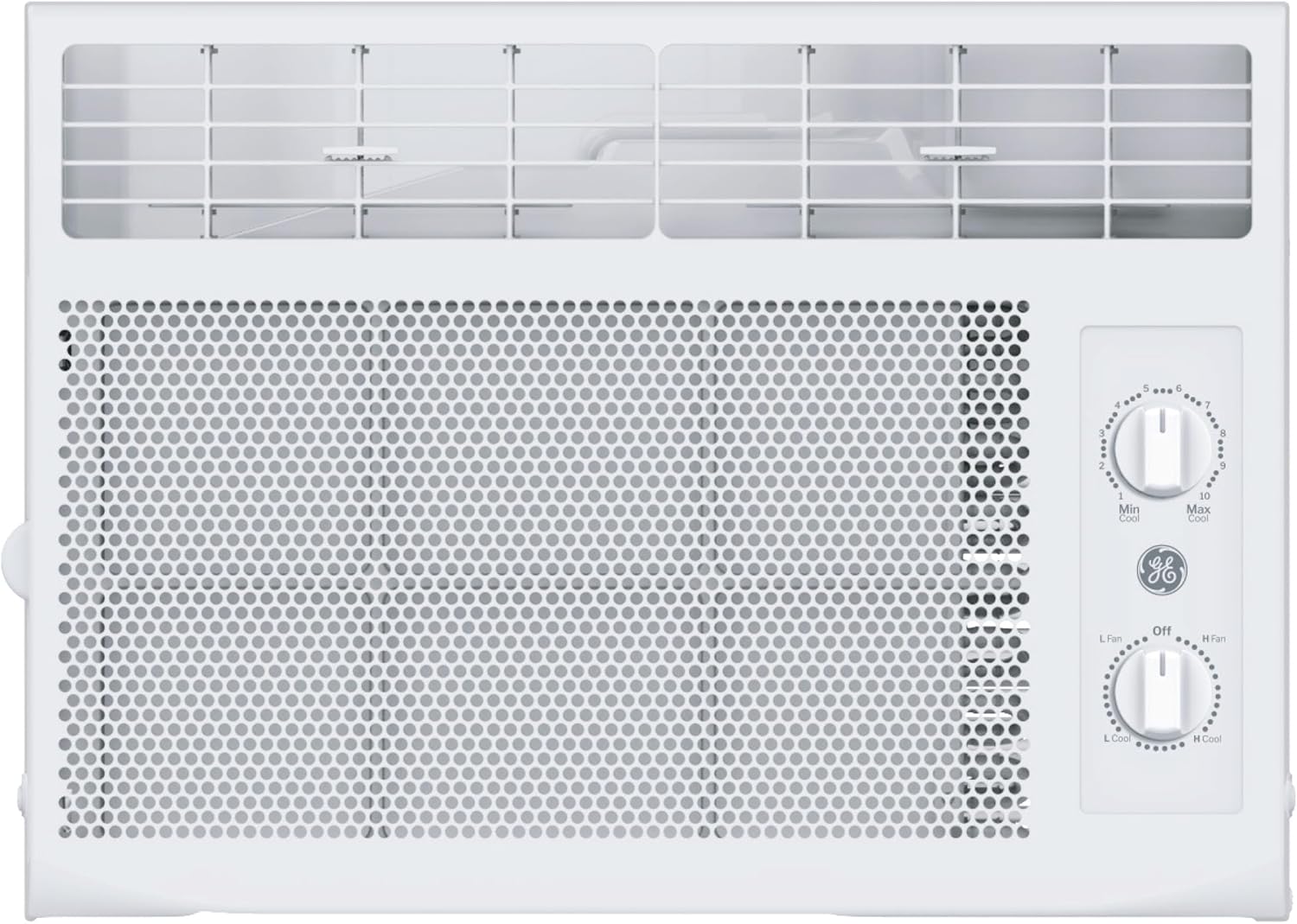
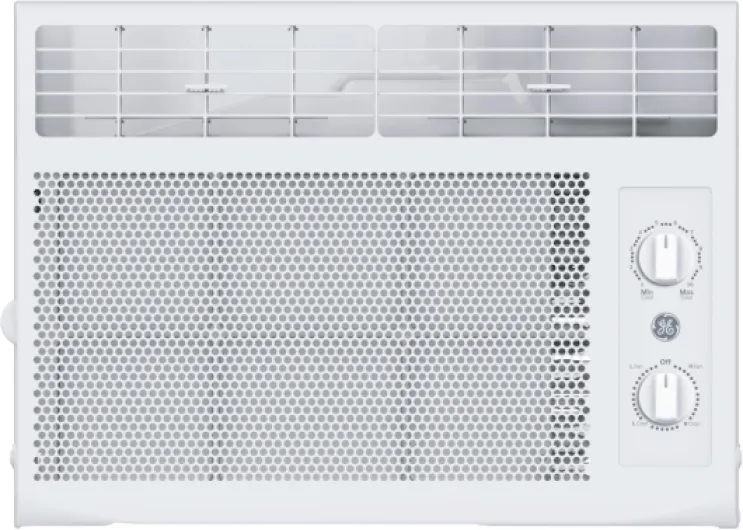
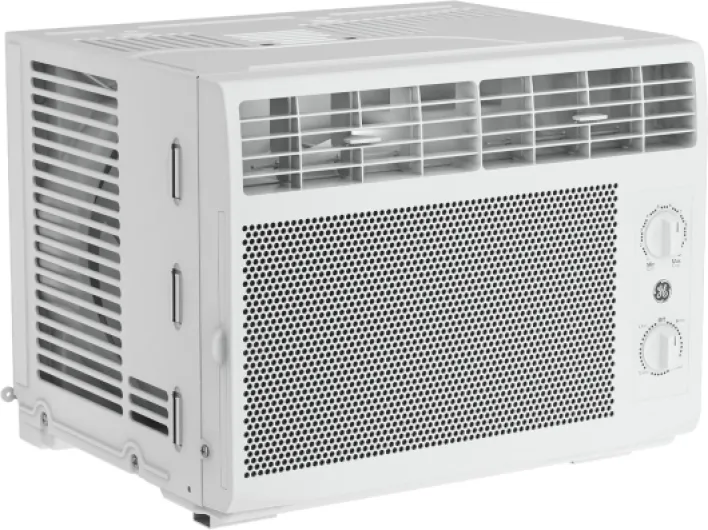
Visually, this GE 5,000 BTU unit is as simple as it gets: a white plastic front grille, two rotary dials on the right, and basic adjustable louvers. There is no glossy black strip, no chrome accent, and no digital display to dress it up. For some people that will feel dated, for others it is exactly what they want in a rental, guest room, or Airbnb where neutrality is a plus. The compact dimensions (about 16.36" wide and 12.59" high) help it fit in smaller window openings where bulkier ACs would be a problem.
The airflow direction is somewhat limited compared with more elaborate units. One buyer points out that the outlet vent only allows side-to-side adjustment and lacks up-and-down vane control. That means you cannot angle the air downward or upward as precisely as on some competitors. In a small 150 sq ft bedroom, that is usually acceptable, but if the unit is installed directly above a bed or desk, the inability to fine-tune vertical airflow could be annoying for sensitive users.
The control layout is extremely straightforward: one larger thermostat knob with roughly 10 temperature settings and another for mode/speed selection (fan only, cool low, cool high, etc.). Several reviews highlight how much they appreciate these analog knobs because they are easy to read, easy to turn, and generally more durable than cheap touch panels. There is no backlighting, so nighttime adjustments rely on feel rather than visuals, but that is the tradeoff of going full mechanical.
From a design standpoint, the unit is clearly built around function and low cost rather than aesthetics. There is enough grille surface to allow decent airflow, a removable filter access point, and accordion side panels that close the window gap. In my opinion, the design is practical for most users: it blends into a white window frame, does not draw attention, and is compact enough not to dominate a small room. People who want a more stylish or slim profile AC will probably have to move to higher-priced series or brands that focus more on design than on budget-friendly cooling.
Comfort, noise, and everyday experience according to buyers
Comfort with a window AC is mostly about three things: how fast it cools, how stable the temperature feels, and whether the noise is tolerable. On cooling speed, multiple reviewers say this 5,000 BTU GE unit performs strongly for small rooms. One buyer reports that in a small room that previously struggled with an 8,000 BTU portable unit, this window model brings temperatures down from around 80–81°F to the low- to mid‑70s without difficulty, even with the mechanical thermostat only set around 5–7. Another mentions that in an Airbnb bedroom around 150–200 sq ft, guests consistently describe the room as comfortable and cool enough for good sleep.
On temperature stability, several comments indicate that once the room is cooled, the AC keeps it there without overfreezing. The mechanical thermostat is not as precise as a digital thermostat with degree readout, but people seem to find a setting that works and then just leave it. With 2 cooling modes and 2 fan speeds, you do not get fine-grained control, yet for a small bedroom or office the flexibility appears sufficient. For those who like the room on the cooler side (around 68–70°F), one reviewer notes that this size can be limiting if you try to cool a space larger than the recommended 150 sq ft; they had to keep the bedroom door closed to maintain 70°F.
Noise is often a deal-breaker for window ACs in bedrooms. GE lists 56 dB, and the user feedback is fairly positive here. One Airbnb host says guests actually sleep better with the low steady hum. Another office user points out that colleagues on calls do not mention hearing it, which suggests the sound signature is more of a consistent background noise than an aggressive rattle or whine. There are still comments saying it is “not the quietest,” but buyers often add that it is quieter than their previous portable units and acceptable for sleeping as long as the bed is not directly in front of the unit.
In my opinion, comfort is a clear strong point for this model within its intended use: small closed room, door mostly shut, realistic expectations about noise. If you try to cool a much larger area, or if you are extremely sensitive to any fan noise at night, you might want a higher BTU unit or a model that is specifically marketed as ultra‑quiet. But for most users with a 10×12 ft or 12×12 ft bedroom, the balance between cooling power and background hum seems to satisfy the majority of reviewers.
Build, filter, and long-term reliability signals
Durability is harder to judge without long-term lab data, but there are a few clues here: brand reputation, design choices, and user comments. GE is one of the major names in window ACs in the US, and this model is high in the window AC sales rankings with nearly 12,000 ratings. That kind of volume, combined with a 4.2/5 average, usually indicates the product does not have a widespread failure issue, or the score would drop more sharply over time. The 1‑year limited warranty is standard in this category; it does not scream premium, but it is acceptable for a budget window unit.
Mechanically, the use of analog controls is actually a plus for longevity. Rotary thermostats and simple switches tend to be more robust than low-cost touch panels, which are frequent failure points on cheap ACs. Several buyers praise the knobs, saying they feel like they will last longer and are less prone to glitches. The fixed chassis design also means fewer moving mechanical interfaces between an inner and outer shell, which can reduce rattling as the product ages, though it does not guarantee it.
Maintenance-wise, the removable and washable filter is an important part of long-term performance. One reviewer mentions a practical annoyance: the side-sliding filter can be tricky to reinsert because it catches near the end of the track and tends to bend if you are not careful. This is more of a usability issue than a reliability disaster, but if the filter frame is repeatedly bent, it could affect how well it seals and how easy it is to keep dust out of the coils. On the positive side, having a washable filter at all helps keep running costs low and supports long-term airflow if users actually clean it regularly.
In my opinion, there is nothing in the specs or comments to suggest this GE model is unusually fragile. At the same time, you should not expect premium materials or commercial-grade construction at this price and weight. If you install it securely using the EZ Mount kit, keep the filter clean, and avoid oversizing expectations (i.e., not running it 24/7 to cool an area twice its rated size), it should deliver several seasons of service like most mainstream window units. For heavy use in harsh climates, stepping up to a slightly higher-end model or ensuring good window support might be a safer bet.
Cooling performance and noise: how it holds up in real rooms
On paper, 5,000 BTU for up to 150 sq ft is a classic pairing for a small bedroom, office, or guest room. The SEER 11.0 value is modest but appropriate for a budget-friendly window unit. Several reviews back up that this GE model delivers stronger real-world cooling than similarly rated or even higher-BTU portable units. One user directly compares it to an 8,000 BTU single-hose portable AC that struggled to drop a room from 80–81°F to 75–76°F; the GE window unit, in the same small room, reportedly gets it to around 70–75°F without pushing the dial to the maximum.
Another buyer uses a 5,000 BTU GE unit in a bedroom where their partner prefers 70°F while the rest of the house stays at 76°F via central air. Their feedback is that this size is "too small for the job" when they leave the door open and expect it to influence more of the house. That aligns with the spec: 5,000 BTU is really designed for a single, mostly closed space. In a properly sized 150 sq ft room, though, other reviewers mention quick cool-down and stable comfort, especially when windows and doors stay shut.
Noise-wise, the advertised 56 dB puts it in the mid-range. Buyers regularly describe the sound as a constant hum rather than a harsh noise. One comment notes it is slightly quieter than a previous portable AC when standing directly in front, and noticeably quieter when you are off to the side because the compressor and fan sit mostly outside the wall. Others say it is quiet enough for sleep and for video calls. There are no widespread complaints about rattling or buzzing in the comments provided, which is reassuring for a unit at this price.
In my opinion, the performance picture is clear: this is a solid cooler for one small room, not a whole-house solution. If you stay within the 150 sq ft recommendation and keep the room reasonably insulated, you can reasonably expect it to bring summer temperatures into a comfortable range and hold them. If you try to stretch it to 200+ sq ft or leave doors open to cool adjacent rooms, reviews suggest you will hit its limits and may want to look at 6,000–8,000 BTU units instead. For noise, it looks acceptable for most people but not for someone who demands near-silent operation.

What this 5,000 BTU GE window unit actually offers
This GE window air conditioner is a compact 5,000 BTU model designed for rooms up to about 150 sq ft. The official dimensions are roughly 15" deep by 16.36" wide by 12.56" high, with a weight of about 36.5 pounds. It runs on standard 115 V power and uses R‑32 refrigerant, which is fairly common in newer ACs because it has a lower global warming potential than older gases like R‑410A. The Seasonal Energy Efficiency Ratio (SEER) is listed at 11.0, which is decent but not cutting-edge; it’s in the range you expect for an entry-level small window unit, not a premium high-efficiency model.
The controls are entirely mechanical: two rotary knobs give access to 2 cooling modes, 2 fan speeds, and about 10 thermostat settings. There is no digital display, no remote, no Wi‑Fi, and no programmable timer. Some people see that as a limitation, but several reviewers explicitly say they like the analog controls because there is less to glitch over time. For those who still want automation, one buyer mentions planning to put the unit on a smart plug to emulate a basic timer or schedule, which is a practical workaround.
Installation is meant for double-hung windows with an opening width from about 27.125" to 36" and a minimum height of 13.375". GE includes an EZ Mount installation kit with side panels and brackets. Many comments describe setup as straightforward and doable in under an hour, partly because the 36.5 lb weight is manageable compared with heavier 8,000–12,000 BTU units. The fixed chassis design means it stays as a single block rather than a slide-out case, which is simpler but requires lifting the whole unit during install and removal.
On the features side, the spec sheet is intentionally minimal: washable filter, basic fan-only mode, low-noise marketing claim, and a 1‑year limited warranty from GE Appliances. In my opinion, this is clearly built as an entry-level workhorse rather than a feature showcase. If you want eco modes, timers, or sleep profiles, GE’s electronic-control models higher up the range are better candidates. If your priority is low purchase cost, brand backing, and enough cooling to make a small bedroom actually comfortable in summer, this configuration fits that brief.
Pros
- Strong cooling for small rooms compared with many portable ACs
- Simple, durable mechanical controls with no complex electronics
- Compact and relatively light design with EZ Mount kit for easier installation
Cons
- Limited to small rooms around 150 sq ft; underpowered for larger spaces
- No timer, remote, or smart features; very basic feature set
- Air outlet lacks vertical adjustment and the filter can be fiddly to reinsert
Conclusion
Analysis score
This GE 5,000 BTU window air conditioner is a straightforward tool: it is built to cool one small room at low cost, with minimal features and minimal fuss. The specs are basic—mechanical knobs, 2 cooling modes, 2 fan speeds, SEER 11.0—but the Amazon feedback suggests it does that simple job quite well. Buyers often report stronger cooling and better comfort than with similarly priced portable units, which matches what you would expect from a window design. Noise levels are not ultra-low, yet many people describe the sound as a steady hum that works fine for sleep and video calls.
It is not perfect. The lack of a timer, remote, or smart functions will frustrate anyone used to more modern ACs, and the 5,000 BTU capacity is clearly limited to rooms around 150 sq ft with the door mostly closed. The filter insertion quirk and the limited vertical airflow adjustment are small but real annoyances. In my opinion, though, the overall package is solid for the category: you get a compact, brand-name unit with decent efficiency, a washable filter, an easy install kit, and a strong pool of mostly satisfied buyers backing up its effectiveness.
This model is ideal if you need to cool a small bedroom, office, dorm, or Airbnb room, you are fine with manual knobs, and you want to keep the upfront cost down. You should probably skip it if you want to cool a large living room, demand ultra-quiet operation, or care a lot about smart features and precise digital control. Used within its limits, it looks like a sensible, good-value choice for basic summer comfort.