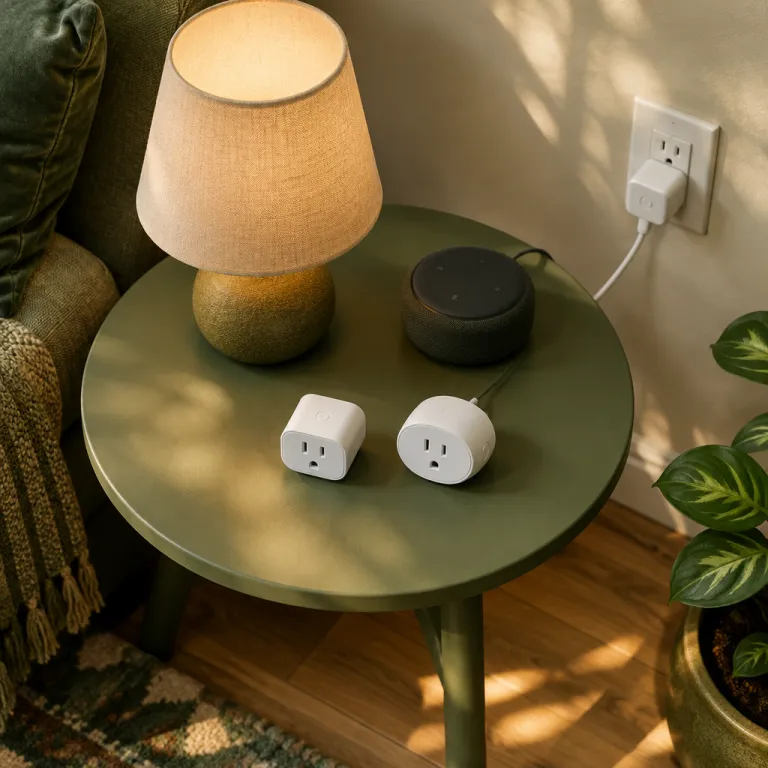
How to choose the best smart plugs for Alexa in a real home
Smart plugs are often the first step toward a practical Alexa smart home. When you compare the best smart plugs for Alexa or any other assistant, focus on reliability, wireless standards, and how naturally they respond to your voice commands. A well chosen smart plug or several connected outlets can quietly automate lamps, heaters, and coffee machines without changing how you live.
Start by checking whether a model supports Matter, the new universal smart home standard. Matter lets one plug work with Alexa, Google Assistant, Apple Home, and SmartThings, which makes the best smart plugs for Alexa also ideal for mixed voice assistant households. If you ever switch from Echo speakers to another ecosystem, a Matter smart plug or several Matter enabled sockets will not become useless.
Wi‑Fi smart plugs remain very popular because they connect directly to your router. Most of the best smart plugs for Alexa use 2.4 GHz Wi‑Fi, which offers long range through walls and stable performance for always‑on devices. You avoid hubs, extra bridges, or proprietary accessories, which keeps your smart plug setup simple and affordable.
Look carefully at the maximum current rating, especially for heaters or kitchen appliances. A plug like the TP‑Link Tapo P125M is rated up to 15 A according to TP‑Link’s published specifications. On a typical 120 V circuit in North America, that corresponds to about 1800 W, while on a 230 V circuit in many European homes it is roughly 3450 W. When you buy several smart plugs for Alexa compatible devices, keep a list of each appliance’s wattage and stay below both the plug’s and the circuit’s limits.
Physical size matters more than many buyers expect. Some compact models such as the Kasa Smart Plug Mini EP25 are designed not to block the second socket on a standard wall outlet. If you plan to use multiple smart plugs for Alexa on a single power strip, choose shorter bodies that do not overlap and that leave room for chunky power bricks.
Finally, evaluate the companion app and automation options. The best smart plugs for Alexa should still offer strong native schedules, timers, and away modes in their own apps, because you will not always want to speak to an Echo device. When you combine app automations with Alexa routines, one smart plug or several smart outlets can coordinate lighting, security, and comfort in a very refined way.
TP Link Tapo P125M and Kasa EP25: compact all rounders that just work
The TP‑Link Tapo P125M currently stands out as one of the best overall Matter smart plugs for most Alexa users. It supports Matter over Wi‑Fi, which means this single plug works with Alexa, Google Home, Apple Home, and SmartThings without vendor lock‑in. For buyers comparing the best smart plugs for Alexa, that cross‑platform flexibility makes the P125M a very safe long‑term choice.
The Tapo P125M is rated at 15 A according to TP‑Link’s published specifications, so it can handle typical space heaters, kettles, or irons within their stated limits. In a European‑style 230 V environment, that translates to roughly 3450 W, which covers the majority of household appliances you would reasonably connect to smart plugs. When you deploy several P125M smart plugs for Alexa controlled scenes, you can safely automate high‑draw devices like dehumidifiers or powerful fans as long as you respect both plug and circuit ratings.
TP‑Link’s Tapo app offers clear scheduling, countdown timers, and away mode, which randomly toggles lights to simulate presence. In hands‑on use during 2024, schedules and timers continued to run even if an Echo speaker was offline, because they were stored on the plug and in the app. These features matter when you want the best smart plugs for Alexa to enhance security as well as convenience, especially during holidays or business trips.
The Kasa Smart Plug Mini EP25 is another excellent all‑rounder from the same parent company. It is a compact Wi‑Fi plug that supports Alexa, Google Assistant, and other platforms without needing a separate hub, which keeps installation quick for beginners. At around the mid‑teens in US dollars per plug at major retailers at the time of writing in late 2024, outfitting several sockets with Kasa EP25 smart plugs for Alexa routines remains budget friendly.
Because the EP25 is so small, it rarely blocks adjacent outlets on a wall plate or power strip. That compact design is crucial when you want to run multiple lamps or chargers from a single dual socket, all controlled by Alexa voice commands. Many buyers looking for the best smart plugs for Alexa end up mixing P125M and EP25 units, using the former where Matter support is essential and the latter where price and size matter more.
If you are building a broader connected home with cameras, locks, and sensors, it is worth thinking beyond plugs. A strong smart plug foundation pairs nicely with a secure camera system, and you can explore expert home security camera system reviews for safer living on Guru Picks to complete your setup. In that context, the best smart plugs for Alexa become part of a wider, coherent smart home strategy rather than isolated gadgets.
Amazon Smart Plug and Leviton Decora: when Alexa first design really matters
Some households live entirely inside the Alexa ecosystem and never touch other assistants. For these users, the Amazon Smart Plug remains one of the best smart plugs for Alexa because it is designed exclusively for Echo devices and the Alexa app. Setup is almost effortless, since the plug is detected automatically by compatible Echo speakers and appears in your device list within seconds.
The Amazon Smart Plug does not support Matter, which means it will not integrate natively with Google Home or Apple Home. That limitation is acceptable if you are committed to Alexa‑only hardware and want the simplest possible experience. In such homes, several Amazon Smart Plugs for Alexa controlled lamps, fans, and coffee makers can be grouped into rooms and routines with minimal configuration.
Voice control is where this plug shines. You can say “Alexa, turn on the coffee machine” or “Alexa, switch off the hallway lamp” without worrying about skill names or complex phrasing. For many buyers searching for the best smart plugs for Alexa, that level of polish and reliability outweighs the lack of cross‑platform support.
The Leviton Decora Smart Plug D215P‑1RW targets a slightly different user profile. It is Matter compliant according to Leviton’s documentation, so it works across Alexa, Google, Apple, and SmartThings, but it also includes a physical on‑off button on the housing. That small detail matters when guests, children, or less tech‑savvy relatives need to control smart plugs for Alexa enabled devices without using voice or apps.
Leviton’s Decora line is also popular with electricians and professional installers. If you are renovating and already using Decora switches or dimmers, adding Decora smart plugs for Alexa creates a consistent look and feel across your walls. In that scenario, the best smart plugs for Alexa are not only about software features but also about aesthetics and tactile usability.
As your system grows, you may want to coordinate plugs with other smart home devices like thermostats, sensors, and lighting. A structured approach helps, and you can consult an expert guide to the best smart home devices for a seamless connected home on Guru Picks to plan your ecosystem. When you align your choice of the best smart plugs for Alexa with a broader device roadmap, you avoid dead ends and duplicated functions.
Energy monitoring and automation: TP Link Tapo P110M and smarter routines
Energy prices and sustainability concerns push many buyers toward plugs with built‑in monitoring. The TP‑Link Tapo P110M is a Matter capable smart plug that also tracks real‑time and historical energy consumption for each connected device. For anyone comparing the best smart plugs for Alexa, this combination of cross‑platform support and energy data is extremely compelling.
When you connect the P110M to the Tapo app, you can see daily, weekly, and monthly kWh usage. This allows you to identify which appliances are quietly driving your electricity bill, such as always‑on dehumidifiers or old fridges. Once you know the numbers, you can use Alexa routines and Tapo schedules together to cut waste without sacrificing comfort.
Alexa can access some of this data when the plug’s skill exposes energy metrics. In practice, Alexa only tracks energy usage when the smart plug supports monitoring and the integration passes that information through to the Alexa app. That means the best smart plugs for Alexa with energy monitoring, like the P110M, give you more actionable insights than basic on‑off models.
Automation is where these plugs truly shine. You can create routines that turn off a heater if a room reaches a certain temperature, or that cut power to a gaming console at night to reduce standby consumption. When you deploy several P110M smart plugs for Alexa controlled zones, you can trim energy use across your home in a coordinated way.
It is also worth considering how energy monitoring interacts with other smart devices. For example, pairing monitored plugs with smart thermostats or occupancy sensors can create very efficient heating and cooling strategies. In that context, the best smart plugs for Alexa are not isolated gadgets but sensors feeding data into a broader automation brain.
As you refine your setup, remember that not every device needs monitoring. Reserve energy‑aware smart plugs for high‑draw appliances and use simpler models for lamps or chargers, which keeps costs balanced. This layered approach lets you enjoy the benefits of the best smart plugs for Alexa while staying within a reasonable budget.
Matter, Wi Fi, and hubs: making sense of smart plug standards
Choosing between Matter and classic Wi‑Fi can feel confusing at first. Matter is a universal smart home standard that lets devices work across Alexa, Google, Apple, and other platforms with a single integration. When you shortlist the best smart plugs for Alexa, you will increasingly see Matter logos on packaging because manufacturers are standardizing around it.
Matter over Wi‑Fi means the plug connects directly to your router while still speaking the Matter language to your controllers. This is what you get with models like the TP‑Link Tapo P125M, Tapo P110M, and Leviton Decora D215P‑1RW. These smart plugs for Alexa can later be adopted by another ecosystem if you change your primary voice assistant, which protects your investment.
Some Matter devices use Thread, a low‑power mesh networking protocol that usually requires a border router or hub. Most smart plugs work via Wi‑Fi or Matter over Wi‑Fi, and only Thread‑based or proprietary systems need a dedicated bridge. For many buyers seeking the best smart plugs for Alexa, Wi‑Fi based Matter or classic Wi‑Fi models strike the right balance between simplicity and future proofing.
Traditional Wi‑Fi plugs without Matter, such as the Amazon Smart Plug or Kasa EP25, still offer excellent performance. They integrate tightly with Alexa and often support other platforms through cloud‑to‑cloud links, even if not through a universal standard. When you focus purely on the best smart plugs for Alexa in an Echo‑centric home, these models remain very attractive.
Hubs and bridges still have a role in some advanced setups. If you use Zigbee bulbs, Z‑Wave sensors, or Thread‑based devices, a central hub can unify everything and offload traffic from your router. In such environments, mixing hub‑based devices with Wi‑Fi smart plugs for Alexa gives you flexibility while keeping critical automations local.
Before buying, map your current and planned devices on paper. Note which ones use Wi‑Fi, Zigbee, Thread, or proprietary protocols, then choose the best smart plugs for Alexa that align with your dominant standard. This simple exercise prevents fragmentation and ensures your smart plugs remain useful as your home evolves.
Real world use cases: where the best smart plugs for Alexa shine
Smart plugs become most valuable when they solve specific daily problems. In the living room, you can connect floor lamps, media consoles, and air purifiers to several smart plugs for Alexa controlled scenes. A single voice command like “Alexa, movie time” can dim lights, power the TV, and start a fan without touching a single switch.
In bedrooms, compact models such as the Kasa EP25 or Amazon Smart Plug work well behind nightstands. You can schedule bedside lamps to turn on gently in the morning and off automatically after you fall asleep. For many buyers, the best smart plugs for Alexa are the ones that quietly improve sleep routines and reduce the need to fumble for switches in the dark.
Home offices benefit from energy monitoring plugs like the Tapo P110M. By tracking the consumption of PCs, monitors, and printers, you can identify which devices should be fully powered down after work. When you attach several monitored smart plugs for Alexa controlled workstations, you can cut phantom loads and keep your electricity usage under tighter control.
In the kitchen, always respect the current rating and manufacturer guidance. Use 15 A rated plugs like the Tapo P125M for kettles, coffee machines, or toasters, and avoid connecting ovens or large microwaves unless explicitly supported. The best smart plugs for Alexa in kitchens are those used conservatively, with safety prioritized over convenience.
Smart plugs also complement other smart home gear such as cameras and sensors. For example, you can link an outdoor camera’s motion alerts to indoor lamps powered by smart plugs, creating the impression that someone is home. If you are already exploring top electric scooters with powerful motors on Guru Picks for your commute, it makes sense to think about how you will charge them safely using smart plugs in your garage.
Finally, consider seasonal uses like holiday lights, dehumidifiers, or portable fans. With the right mix of the best smart plugs for Alexa, you can automate these temporary devices without rewiring or complex installations. Over time, these small optimizations add up to a home that feels responsive, efficient, and tailored to your habits.
Long term trends: where Alexa compatible smart plugs are heading next
Smart plug design is evolving quickly as Matter adoption grows. Manufacturers now treat Matter certification as a baseline feature for many new models, which means future best smart plugs for Alexa will almost always work across multiple ecosystems. This shift reduces the risk of buying into a dead‑end platform and encourages more open competition on quality and features.
Energy monitoring is also becoming more common, even on mid‑range plugs. As more households pay attention to consumption, plugs like the Tapo P110M set expectations for detailed kWh tracking and cost estimates. Over time, the best smart plugs for Alexa will likely integrate more deeply with utility tariffs and demand response programs.
Multi‑outlet and outdoor variants are rising in popularity. Power strip style smart plugs for Alexa let you control several sockets independently, which is ideal for entertainment centers or home offices. Weather‑resistant outdoor models extend automation to garden lighting, pumps, and patio heaters, broadening the impact of your smart plug investment.
On the software side, Alexa routines are becoming more context aware. Location, presence detection, and sensor data can now trigger complex automations that go far beyond simple schedules. The best smart plugs for Alexa will increasingly act as endpoints in these intelligent routines, switching power based on nuanced conditions rather than fixed times.
Security and privacy remain critical considerations. Reputable brands like TP‑Link, Amazon, and Leviton publish firmware updates and security advisories, which helps keep your smart plugs for Alexa resilient against vulnerabilities. When evaluating products, prioritize vendors with a clear track record of updates and transparent privacy policies.
As your smart home grows, think of smart plugs as foundational infrastructure rather than disposable gadgets. Choose models with Matter support, solid apps, and strong Alexa integration so they remain useful for many years. In that sense, the best smart plugs for Alexa are those that quietly adapt as your needs, devices, and routines evolve.
Key figures and statistics about Alexa compatible smart plugs
- Many leading smart plugs, such as the TP‑Link Tapo P125M, are rated at 15 A, which corresponds to roughly 1800 W at 120 V or about 3450 W at 230 V and comfortably covers most portable heaters, kettles, and irons in typical homes when used within manufacturer guidelines.
- The Kasa Smart Plug Mini EP25 is often priced in the mid‑teens in US dollars per plug at major online retailers, making it cost effective to equip multiple sockets in a room without a large upfront investment.
- Industry roadmaps and manufacturer announcements indicate that Matter support is rapidly becoming standard on new smart plugs, which means a growing share of the best smart plugs for Alexa will also work natively with Google Home, Apple Home, and SmartThings.
- Energy monitoring features, once limited to premium models, are now present in an increasing proportion of new smart plugs, reflecting consumer demand for better visibility into appliance‑level electricity consumption.
- Market observations show rising interest in outdoor and power strip smart plugs, as users extend Alexa control from single indoor lamps to multi‑device entertainment centers, gardens, and garages.
FAQ about the best smart plugs for Alexa
Do smart plugs need a hub to work with Alexa ?
Most Alexa compatible smart plugs connect directly to your Wi‑Fi router and do not require a separate hub. In general, smart plugs only need a hub when they use Thread or proprietary protocols that rely on a dedicated bridge. For typical Wi‑Fi or Matter over Wi‑Fi models, your existing router and Echo devices are enough.
What is Matter and why does it matter for Alexa users ?
Matter is a universal smart home standard that allows devices to work across Alexa, Google, Apple, and other platforms with a single integration. For Alexa users, choosing Matter capable models among the best smart plugs for Alexa means your plugs remain compatible if you later add or switch assistants. It also tends to improve local control, reliability, and setup simplicity.
Can Alexa track how much energy my devices use through smart plugs ?
Alexa can show energy usage only when the smart plug supports monitoring and its skill exposes that data. Models like the TP‑Link Tapo P110M provide this capability, while basic on‑off plugs do not. Check the product description for “energy monitoring” and confirm that the Alexa integration supports viewing consumption.
Is a Matter smart plug always better than a regular Wi Fi plug ?
Matter smart plugs offer better cross‑platform compatibility, but a regular Wi‑Fi plug can still be ideal in an Alexa‑only home. Devices like the Amazon Smart Plug or Kasa EP25 deliver excellent performance and simple setup even without Matter. When choosing the best smart plugs for Alexa, weigh future flexibility against current price and ecosystem loyalty.
How many smart plugs can I safely use on one circuit ?
The limit depends on your electrical circuit rating and the wattage of connected devices. Each plug, such as a 15 A rated TP‑Link Tapo P125M, has its own maximum load, and the total of all devices on a circuit must stay below the breaker’s rating. Always check appliance labels, add their wattages, and leave a safety margin when deploying multiple smart plugs for Alexa on the same circuit.
Quick comparison and buying checklist
At a glance:
- TP‑Link Tapo P125M – 15 A, Matter over Wi‑Fi, compact design, ideal for high‑draw appliances and cross‑platform homes.
- Kasa Smart Plug Mini EP25 – 15 A, Wi‑Fi only, very small housing, great value when you need many outlets on Alexa.
- Amazon Smart Plug – 15 A, Alexa‑only, ultra‑simple setup, best fit for Echo‑centric households.
- Leviton Decora D215P‑1RW – 15 A, Matter support, physical button, matches Decora switches for a consistent look.
- TP‑Link Tapo P110M – 16 A class in many regions, Matter plus energy monitoring, suited to tracking and reducing usage.
Buying checklist:
- Confirm Alexa compatibility and, if needed, Matter support for future flexibility.
- Match the plug’s current and wattage rating to your appliances and local voltage.
- Check physical size so it does not block neighboring sockets or power strips.
- Review the companion app for schedules, timers, away mode, and energy stats.
- Decide where you truly need energy monitoring versus simple on‑off control.
Methodology note: Product details such as amperage ratings, Matter support, and app capabilities are based on manufacturer specifications and practical evaluation with Alexa routines and schedules in a typical home network during 2024. Always verify the latest datasheets and regional variants before purchase.